Roasted Clutches, Flat Tires, and Somehow a Podium
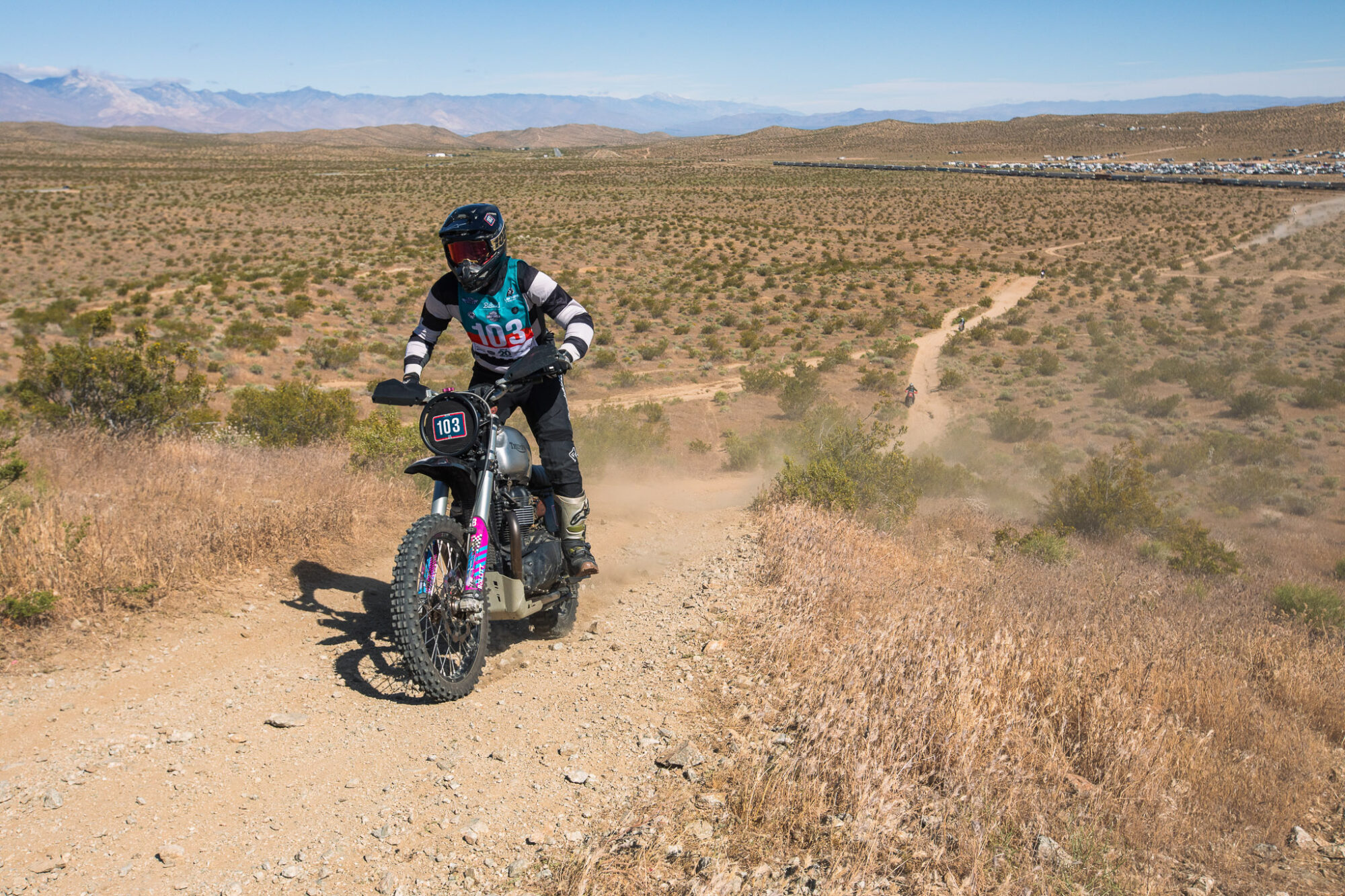
Photo: Ed Subias
I hadn’t ridden much of anything since tearing my AC joint on MLK Day earlier that January, so the only real pre-running I was going to get happened Friday afternoon before the race. We had just gotten back from Ireland the day before I loaded the bike and headed for the desert.
Sketchy Prep

Photo: Geoff Kowalchuk
To make matters worse, my shocks were completely blown. I dug an old set of Works Performance shocks out of the garage and threw them on the bike. It wasn’t until I started bolting everything together that I realized they were over an inch shorter than my Nitron shocks.
Friday’s pre-run confirmed exactly what I feared. The bike was bottoming out everywhere. The noise alone was distracting, and I knew it was going to become a real problem once the race started.
Back at camp, Brandon and I started trying to figure out anything we could do to help the clearance situation. Removing the rear fender and license plate bracket gave me another inch or so before bottoming out, and it also eliminated a couple bolts that were chewing into my Michelin tire.
We pulled the fender, raised the shocks as much as we could, and called it good enough. I never even got the chance to test the setup afterward. By that point, race day was coming whether the bike was ready or not.

Photo: Jenny Brookes
Race Morning
I was anxious Saturday morning, but that’s part of racing. Pre-race jitters always show up.
Still, I felt surprisingly confident.
The biggest question wasn’t the bike. It was my shoulder.
After ending the 2025 Sunday race in the ER — and adding another ER visit earlier this January — my wife had made it very clear that she’d prefer I stop testing our health insurance deductible.
“You get one ER visit a year,” she reminded me repeatedly. “You already used yours.”
This was my fifth Biltwell rubber-band start, so the process felt familiar by now. I lined up far right on the grid, figuring it gave me a decent angle heading into the chaos.

Photo: Jenny Brookes
Into the Chaos

Photo: Geoff Kowalchuk
When the band snapped, I got an excellent launch and believe I entered the tunnel first or second in class. Even so, I’d already made the decision not to throw the race away in the first mile. I intentionally dialed things back early, wanting to avoid some hidden dip or mistake ending my day before it really began.
For the first several miles, I settled into third place and started finding a rhythm.

Photo: Gregg Boydston
Before the race, a few riders had warned me that miles six through ten were the hardest section of the course. Somewhere in that stretch, I missed the split between the hard hill climb and the easier route.
I accidentally committed to the hard line.
The Hill Climb

Photo: Ed Subias
Lap one at the Biltwell 100 is complete chaos. Bikes and riders were scattered all over the hill by the time I got there, and once you commit to a rocky climb on a nearly 500-pound bike, stopping isn’t exactly part of the plan.
Trying to maintain momentum, I launched off the side of the course and ended up stuck nearly perpendicular on the side of the hill.
Managing a giant Triumph on a steep, rock-covered incline is brutal. I was revving the absolute life out of the bike trying to free it. At different points the bike was high-centered on rocks, the rear wheel was jammed, and I was completely exhausted less than ten miles into the race.
Eventually I got moving again, but I’d lost somewhere between five and ten minutes.
Not long afterward, I noticed the bike revving incredibly high while barely accelerating. It sounded like the engine was pinned at max RPM with almost no power delivery.
That realization immediately worried me. Sand washes were still ahead, and without power, I was going to be in serious trouble.
The issue kept getting worse until I finally pulled over to inspect the bike.
Once stopped, it wouldn’t engage at all.
No matter what gear I selected, the bike would just rev and go nowhere.
I started panicking. I adjusted clutch cables, played with the lever, checked everything I could think of, but nothing made sense.
Defeated, I pulled out my phone and called Josh at Biltwell to request recovery.
Sitting there on the side of the course watching vintage Harleys — and eventually even Coleman minibikes — pass me felt absolutely brutal. I was angry, exhausted, and convinced my race was over.
Back from the Dead
Since I wasn’t injured, I knew recovery would take a while. After sitting there for about thirty minutes filming riders go by, I decided to mess with the bike one more time.
Then suddenly — clunk.
The bike dropped into gear.
I immediately called race direction back, canceled recovery, threw my helmet and gloves back on, and took off with the simple goal of limping back to the pits.
Oddly enough, the next fifteen miles went smoothly.
The bike pulled through sand washes without issue and felt completely normal again.
Back at camp, Brandon was waiting for me.
“I’m not done yet,” I told him.
Even though I still didn’t fully understand what had happened, I decided I was willing to risk getting stranded again.
Chasing the Race

Photo: Ed Subias
Lap two actually went surprisingly well.
But somewhere during that lap, I started thinking about how much time I’d already lost. I kept replaying the hill climb and wondering what the race might’ve looked like without the mechanical issue.
Realistically, though, losing forty-plus minutes on lap one had already destroyed any real podium chances.
At that point, finishing the race healthy became the priority.
Lap two was relatively drama-free, and when I rolled back into camp, I decided to head out for a third lap.
As much as I wanted to push hard and chase a fast lap time, I kept thinking about last year’s ER visit, the hospital bills still floating around, and the fact that I genuinely wanted to make it home in one piece.
So I rode smart.
Not slow — just smart.

Photo: Ed Subias
Riding on a Flat
By lap three, I had the course mostly memorized. I knew where the deep sand washes were, where the ugly rock sections waited, and where the bigger obstacles would catch you off guard.
After clearing the second deep sand wash around mile nineteen, I started noticing the rear of the bike drifting unpredictably.
It felt like riding on butter.
The bike refused to track straight.
Unfortunately, I was halfway up a rocky uphill section when it started happening, and after everything earlier in the day, there was no chance I was stopping on another hill.
So I pinned it.
The bike bounced violently through rocks and ruts while I desperately tried to keep momentum alive. Somewhere in the chaos, I nearly took out a woman parked in a side-by-side way too close to the race line.
When I finally reached the top, I stopped and looked back.
The rear tire was completely flat.
The bead had separated from the rim, but somehow the tire was still hanging on.
Standing there looking down toward camp and the finish line, I had a quick internal debate about whether I was willing to destroy my rear wheel just to finish the race.
The answer came pretty quickly.
Absolutely.
I carefully worked my way down the rocky descent and spent the next several miles sliding all over the course. At one point, it honestly felt like the rear wheel was trying to pass the front.
I still have no idea how the tire stayed on the bike.
But somehow, it did.
And somehow, I crossed the finish line.

Photo: Gregg Boydston
At that point, simply finishing felt like a massive victory.
A DNF would’ve haunted me.
Instead, I rolled back into camp exhausted, relieved, and genuinely proud that both the bike and I survived the day.
The Protest
During those slower second and third laps, I spent a lot of time replaying the earlier mechanical issue in my head.
The only explanation I could come up with was that I’d absolutely cooked the clutch on the hill climb. Once everything cooled down, the clutch plates started grabbing again.
I’d never fully roasted a clutch before and honestly didn’t realize they could recover like that.
Apparently, they can.
Later that evening, I checked the results.
Despite everything, I was sitting in fourth place.
Then I noticed something strange.
Third place in the Scrambler class was listed as a KTM.
The Scrambler class rules specifically stated the bike needed to be a factory scrambler model. I walked over to race direction and politely asked if they could double-check the bike.
To be fair, they had far bigger problems to deal with than a novice class podium protest, and nobody could immediately verify it.
Still, I couldn’t shake the feeling that the rider had simply entered the class because his original class filled up.
I waited through the awards ceremony, hoping to talk to him directly, but he never showed.
Even so, I kept trying to convince myself that finishing the race was enough.
Truthfully, though, I couldn’t fully let it go.
When I got home Tuesday night, I sent Josh a quick email asking if he could take another look once things settled down.
Wednesday morning, he confirmed my suspicion.
The KTM rider had entered the wrong class and was removed from the results, moving me up to third place.
I missed the chance to stand on the podium with everyone that weekend, but Josh offered to ship me the medal and correct the official standings.
It wasn’t quite the same as spraying champagne in the desert, but it still meant a lot.

Photo: Geoff Kowalchuk
Third Place

Considering where things started — injured shoulder, almost no prep time, questionable suspension, a roasted clutch, and a completely flat rear tire — walking away from the 2026 Biltwell 100 with a finish and a podium spot feels pretty damn special.
Mostly, I’m just grateful.
Grateful for good friends, a stubborn motorcycle, and another chance to line up in the desert.
And if anything, this race only made me want more.
More racing.
More chaos.
More desert.
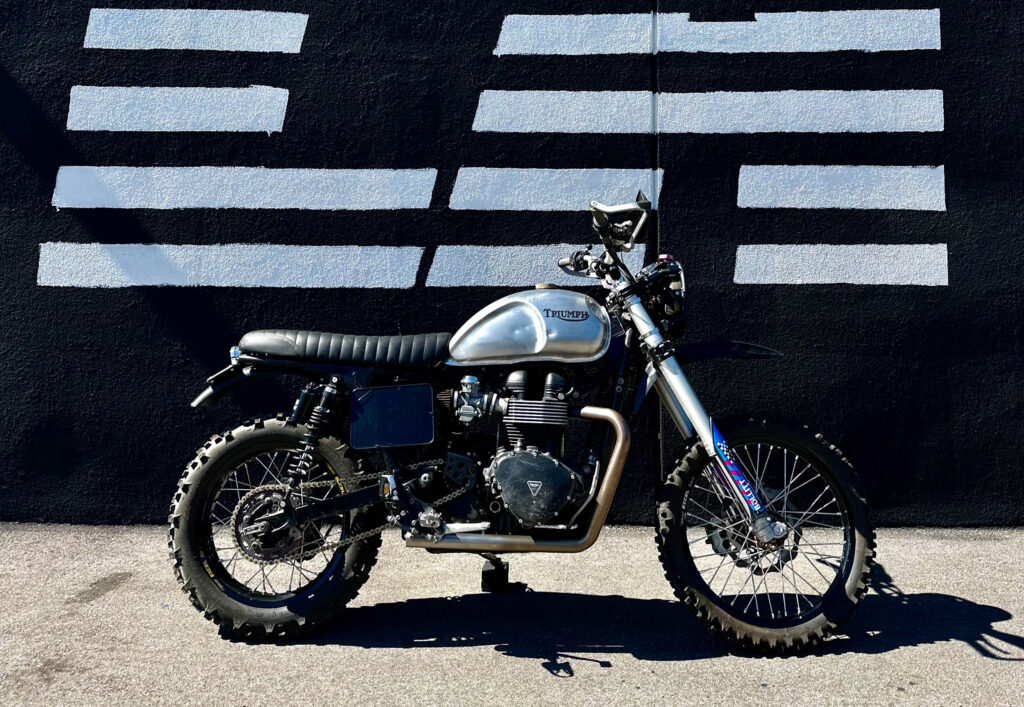
The Bullitt OG2. Bruised, battered, and somehow on the podium.